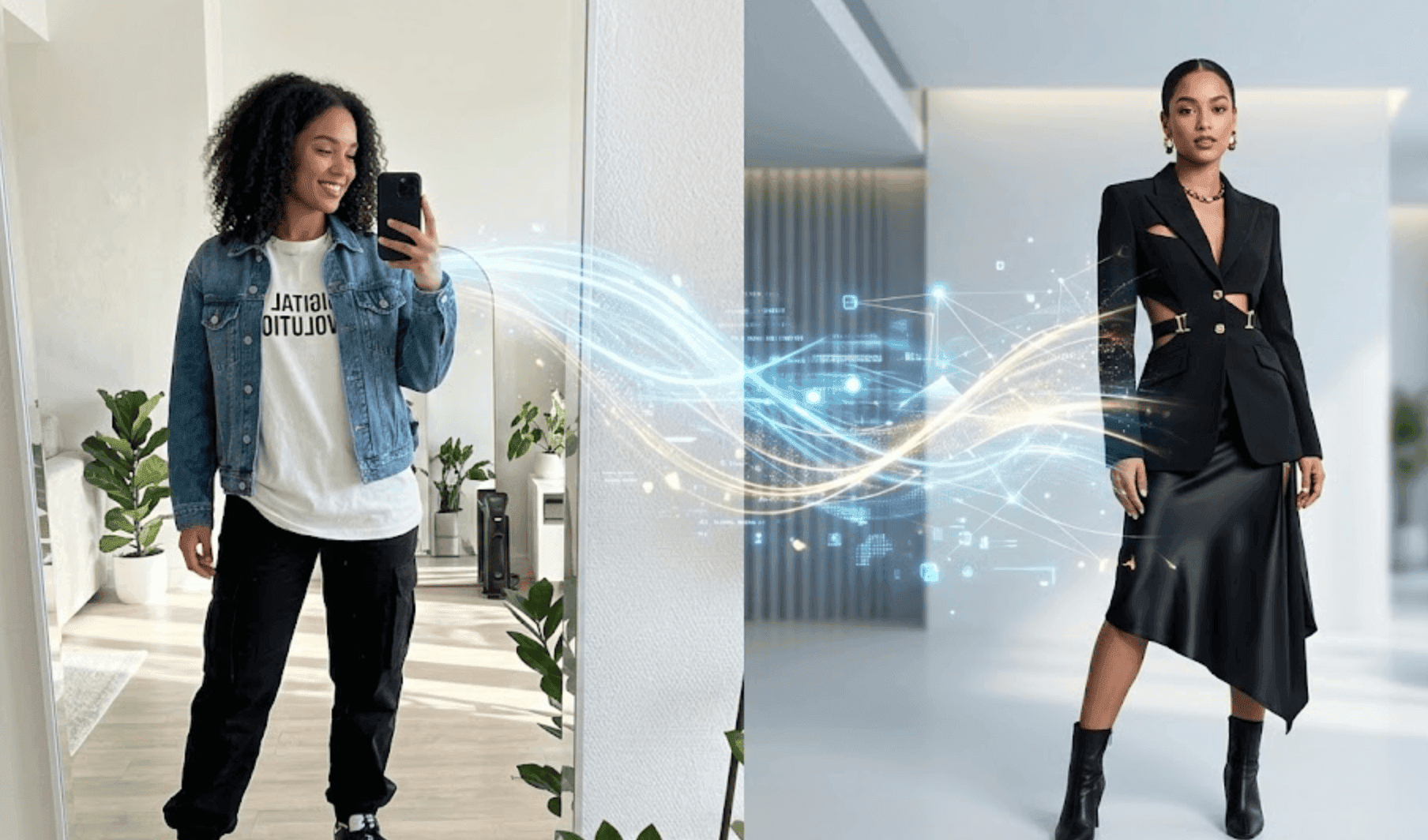
You upload a photo. Seconds later, you’re wearing a completely different outfit. It looks realistic — the fabric drapes naturally, the proportions are right, the lighting matches. But how does it actually work?
Virtual try-on is one of the most exciting applications of generative AI in fashion. Here’s a simplified look at the technology behind it.
The first step is understanding you. When you upload a photo, the AI needs to build a detailed understanding of your body — your proportions, your pose, the way light falls on your skin. This happens through a combination of pose estimation (identifying key body landmarks) and segmentation (separating you from the background).
Next comes the garment. Every piece of clothing has physical properties — how it drapes, how it stretches, how it catches light. The AI learns these properties from training data, understanding that silk behaves differently from denim, and that a structured blazer fits differently from a flowing dress.
The magic happens in the synthesis step. Using diffusion models — the same family of AI that powers image generation — the system “paints” the garment onto your body. But unlike simple overlays or Photoshop tricks, this generation is physics-aware. It considers how the fabric would actually fall on your specific body shape and pose.
One of the hardest challenges is maintaining your identity. The AI needs to change your clothes without changing you — your face, your skin tone, your hair, your expression should all remain exactly the same. This requires careful conditioning and fine-tuning to ensure the model respects what should and shouldn’t change.
The result is a realistic visualization that gives you genuine confidence about how something will look on you. Not a generic model. Not a rough approximation. You, in that outfit, as if you’d actually tried it on.
We’re still early in this technology, and it’s getting better rapidly. Every month, the results get more realistic, the range of garments expands, and the speed increases. At Polyvibe, we’re pushing the boundaries of what’s possible — because we believe everyone deserves to see before they commit.